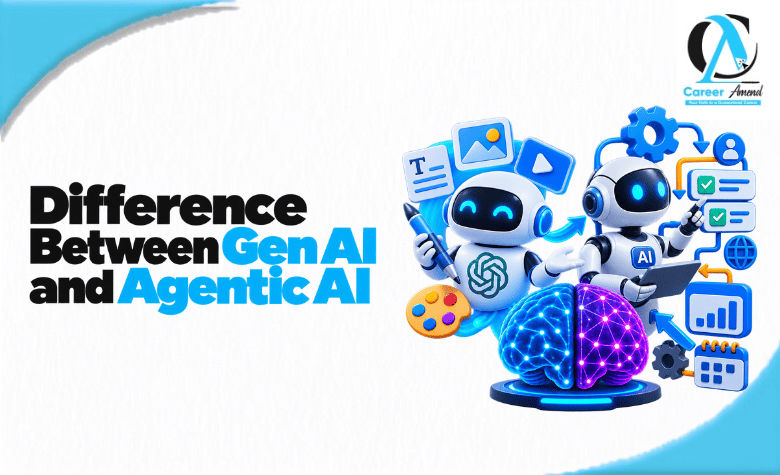
Difference Between Gen AI and Agentic AI: A Complete Guide
- What Is Generative AI?
- How Generative AI Works
- What Is Agentic AI?
- How Agentic AI Works
- Gen AI vs Agentic AI: The Core Difference
- Gen AI Creates; Agentic AI Acts
- Gen AI vs Agentic AI Comparison Table
- Real-World Examples of Gen AI and Agentic AI
- How Generative AI and Agentic AI Work Together
- Benefits and Challenges of Agentic AI
- Is Agentic AI Replacing Generative AI?
- The Future of Gen AI and Agentic AI
- Conclusion:
Artificial intelligence is evolving quickly, and two terms are appearing everywhere: Generative AI (Gen AI) and Agentic AI. Although they sound similar and often work together, they represent different approaches to what artificial intelligence can do. Generative AI is primarily designed to create content and responses, while Agentic AI goes further by pursuing goals, making decisions, using tools, and carrying out multi-step actions with varying degrees of autonomy.
Think of the difference this way: Gen AI is like a talented adviser, while Agentic AI is closer to a digital operator. Ask Generative AI to create a marketing strategy, and it can produce a detailed plan. Give an appropriately configured AI agent a marketing objective, and it may be able to research information, use connected tools, execute permitted tasks, analyze results, and determine what should happen next.
Understanding the difference between Gen AI and Agentic AI matters because businesses are moving from simply using AI to generate information toward using AI to help execute workflows. This guide explains how both technologies work, where they differ, how they complement each other, and what their growing adoption could mean for organizations.
What Is Generative AI?
Generative AI is artificial intelligence designed to generate new content based on patterns learned from large amounts of data. Depending on the model, that content can include text, software code, images, audio, video, structured data, and other digital material. Modern multimodal AI models can also process and generate information across several formats.
The familiar interaction pattern is straightforward: a user provides a prompt, the AI interprets it, and the system generates an output. You might ask Gen AI to summarize a report, draft an email, explain a difficult concept, create product descriptions, analyze text, or generate software code.
Its defining characteristic is generation. The AI produces something useful for the user, but the user generally remains responsible for deciding what happens afterward.
For example, suppose you ask a Gen AI application to develop a social media campaign for a new product. It might generate campaign ideas, posts, hashtags, audience suggestions, and advertising copy. Those outputs could save hours of creative work, but someone still typically reviews the recommendations and decides what to publish.
How Generative AI Works
Generative AI models learn statistical patterns and relationships from training data. Large language models, for instance, work with tokens and use learned relationships, context, and instructions to generate sequences of language. Modern systems may combine this capability with external information retrieval, multimodal inputs, software tools, and other components.
A simple analogy is a highly capable chef. You provide instructions and ingredients, and the chef creates something based on your request. Change the request and you receive a different result.
The basic interaction can therefore be summarized as prompt → processing → generated output.
Gen AI applications can become considerably more sophisticated through techniques such as retrieval-augmented generation and tool calling. Still, access to a tool does not automatically make every AI application an autonomous agent. The crucial question is whether the system simply follows a predefined interaction or can independently determine and execute intermediate steps toward a broader goal.
What Is Agentic AI?
Agentic AI refers to AI systems designed to pursue goals with a meaningful degree of autonomy. Instead of simply answering a prompt, an agentic system can potentially determine which steps are necessary, select appropriate tools, perform authorized actions, observe the results, and adjust its approach.
This represents an important shift. With traditional Gen AI, you might repeatedly tell the AI what to do at each stage. With Agentic AI, you can potentially specify the desired outcome and allow the system to determine parts of the path required to reach it.
Imagine asking an AI system to investigate why customer cancellations increased during the previous month. A conventional Gen AI workflow might require you to retrieve customer data, provide it to the model, request analysis, ask follow-up questions, and manually create a report.
An agentic system connected to appropriate tools could potentially determine what information it needs, query authorized sources, analyze customer patterns, examine support information, compare relevant periods, identify gaps, and prepare its findings. Instead of merely producing content, it is managing a process toward an objective.
How Agentic AI Works
Agentic AI typically combines an AI model with planning, orchestration, memory or state, tools, permissions, and feedback loops. The underlying model provides reasoning and language capabilities, while the surrounding architecture allows the system to interact with other software and respond to changing conditions.
A common agentic workflow resembles:
Goal → Plan → Action → Observation → Adjustment → Next Action
Suppose an AI coding agent receives the goal of fixing a software bug. It could inspect relevant files, analyze logs, develop a hypothesis, edit authorized code, run tests, inspect failures, revise its solution, and test again.
This feedback loop separates agentic systems from simple one-shot generation. The AI is not merely describing what someone else should do. It is taking permitted actions and using the results to determine its next step.
That additional power creates additional responsibility. If AI can modify databases, send communications, execute code, or interact with business systems, organizations need strong permissions, monitoring, security controls, human approval mechanisms, and clear boundaries.
Gen AI vs Agentic AI: The Core Difference
The easiest way to understand Gen AI vs Agentic AI is to examine what happens after the AI understands your request.
Generative AI primarily creates or transforms information. Agentic AI primarily pursues an objective through decisions and actions, often using generative AI as part of the process.
Imagine planning a business trip. You could ask Generative AI to recommend destinations, create an itinerary, suggest what to pack, and draft a travel schedule. The AI gives you information, but you remain responsible for executing the plan.
An agentic travel system with appropriate integrations and permissions could go further. It might examine calendar constraints, research options, adapt its plan when availability changes, and carry out approved steps through connected services.
The difference is therefore not simply which technology is “smarter.” Both can use powerful models. The key difference is agency—how much freedom the system has to decide what needs to happen next and then act within its permitted boundaries.
Gen AI Creates; Agentic AI Acts
A useful shorthand is “Gen AI creates; Agentic AI acts.”
The phrase is intentionally simplified because Agentic AI also generates content, while modern Gen AI applications may use external tools. However, it captures their different emphasis.
Generative AI works particularly well when you know the artifact you want: an article, image, summary, translation, presentation, software function, marketing concept, or explanation.
Agentic AI becomes more relevant when you know the goal but do not necessarily want to specify every intermediate step. Instead of saying, “Create this individual piece of work,” the interaction begins to resemble, “Achieve this objective within these rules.”
This shift also explains why Agentic AI requires stronger governance. There is a major difference between an AI recommending that you update a database record and an AI actually changing that record.
Gen AI vs Agentic AI Comparison Table
The distinction is best understood as a spectrum rather than a rigid wall. Many agentic systems use generative models, while some Gen AI applications incorporate limited agent-like capabilities.
|
Feature |
Generative AI |
Agentic AI |
|
Primary purpose |
Generate or transform content |
Pursue goals and execute tasks |
|
Typical workflow |
Prompt → Response |
Goal → Plan → Act → Observe → Adjust |
|
Autonomy |
Usually lower |
Usually higher |
|
Planning |
Can create plans |
Can use plans to guide actions |
|
Tool usage |
Optional |
Often central |
|
Memory/state |
Application-dependent |
Often important |
|
External actions |
Usually limited |
Common in agentic workflows |
|
Adaptation |
Often user-directed |
Can adapt from feedback |
|
Human involvement |
Frequent |
Can occur at defined checkpoints |
|
Typical result |
Content or recommendation |
Completed task or changed state |
|
Example |
Draft an email |
Execute authorized workflow steps |
|
Main risk |
Incorrect output |
Incorrect output or action |
Real-World Examples of Gen AI and Agentic AI
Examples make the distinction easier to recognize. Generative AI examples include writing articles, creating images, summarizing meetings, translating documents, generating code, drafting customer responses, and explaining complex information.
The primary product in each case is content or information. Even when the model performs sophisticated reasoning, someone generally decides how the resulting output should be used.
Agentic AI crosses the boundary from describing work toward performing parts of the work.
Consider customer service. Gen AI might draft a response for a support representative. An agentic customer-service system could potentially identify the customer's problem, retrieve authorized account information, consult company policies, select an appropriate process, execute permitted actions, and escalate unusual cases to a human.
Software development provides another useful example. Gen AI can generate a code snippet when asked. An AI coding agent may inspect an existing repository, identify relevant files, modify code, execute tests, examine errors, and revise its work.
The industry changes, but the underlying pattern remains similar: observe, reason, act, evaluate, and repeat.
How Generative AI and Agentic AI Work Together
The debate should not really be framed as Agentic AI versus Generative AI because agentic systems frequently depend on generative models.
Think of Gen AI as an engine and agentic architecture as much of the vehicle surrounding that engine. The engine provides power, but reaching a destination requires steering, sensors, controls, and mechanisms that convert power into movement.
Similarly, a large language model can interpret instructions, generate plans, analyze information, produce code, and reason about possible actions. The agentic layer connects those abilities with external tools, memory, APIs, databases, software applications, and execution environments.
For example, the generative model may determine that it needs to query a database. The agent framework manages whether the model has permission, executes the appropriate tool call, captures the result, sends that information back to the model, and tracks the overall workflow.
This architecture explains why building reliable agents involves much more than improving prompts. Developers must consider permissions, authentication, error handling, observability, memory, tool selection, evaluation, security, and human oversight.
Benefits and Challenges of Agentic AI
The biggest potential advantage of Agentic AI is its ability to automate complex, dynamic workflows that traditional rule-based automation struggles to handle.
Traditional automation works beautifully when the steps are predictable: if A happens, perform B and then C. Knowledge work is rarely that tidy. Information may be missing, an API may return an unexpected result, or the correct next action may depend on what happened earlier.
Agentic systems can potentially reason through these changing conditions instead of following only a rigid path. This could make them useful for software development, research, customer service, operations, analytics, cybersecurity, and enterprise workflows.
But autonomy increases risk alongside capability. Giving an AI permission to recommend an action is very different from allowing it to execute that action automatically.
Organizations therefore need to ask practical questions: What data can the agent access? Which actions can it perform? Which decisions require human approval? Can an action be reversed? How are failures detected? Are all actions logged?
More autonomy is not automatically better. The appropriate level depends on the consequences of mistakes and the controls surrounding the system.
Is Agentic AI Replacing Generative AI?
Agentic AI is unlikely to make Generative AI obsolete because the technologies are complementary. In many architectures, generative models provide capabilities that help agents function.
Plenty of tasks also do not need autonomy. If you want an article summarized, a paragraph rewritten, an image generated, or an idea explained, a straightforward Gen AI interaction can be faster and simpler than constructing an autonomous workflow.
Agentic architecture becomes valuable when tasks involve multiple steps, changing information, external systems, tool selection, and repeated decisions.
Businesses are therefore likely to use both approaches. Generative AI can handle content-focused work, while agents can address selected processes where goal-directed execution creates enough value to justify the additional complexity.
Rather than asking which technology will survive, a better question is which level of autonomy is appropriate for each task?
The Future of Gen AI and Agentic AI
The next stage of artificial intelligence is likely to combine powerful generative models with increasingly sophisticated tools, memory, orchestration, multimodal capabilities, and controlled autonomy.
As these systems mature, the competitive question may gradually shift from “Which AI gives the best answer?” toward “Which AI system can reliably accomplish useful work?”
Reliability will become especially important. An agent that performs correctly most of the time can still create serious problems if its occasional errors involve financial transactions, sensitive customer information, production software, or irreversible changes.
The future of Agentic AI will therefore depend on more than increasingly capable models. Organizations will need robust evaluations, transparent action logs, permission systems, human checkpoints, security controls, and mechanisms for stopping or correcting agents.
The exciting possibility is that software becomes increasingly adaptive. Instead of people learning every interface and manually coordinating every application, AI systems could increasingly translate human goals into coordinated digital workflows. The challenge is ensuring that greater agency remains controllable, observable, and aligned with the user's intent.
Conclusion:
The difference between Gen AI and Agentic AI can be summarized in one idea: Generative AI primarily produces outputs, while Agentic AI pursues outcomes.
Generative AI excels at creating text, images, code, summaries, explanations, and other content. Agentic AI builds on AI capabilities by combining them with planning, tools, memory, feedback loops, and the ability to execute permitted actions.
The two technologies are not competitors so much as complementary layers. Generative models can provide the reasoning and creation capabilities behind an agent, while agent architecture turns selected decisions into real-world actions.
For organizations, the most important question is not how much autonomy AI can technically achieve. It is how much autonomy a particular task actually needs. The strongest systems will balance capability with permissions, monitoring, security, and human oversight.
Frequently Asked Questions