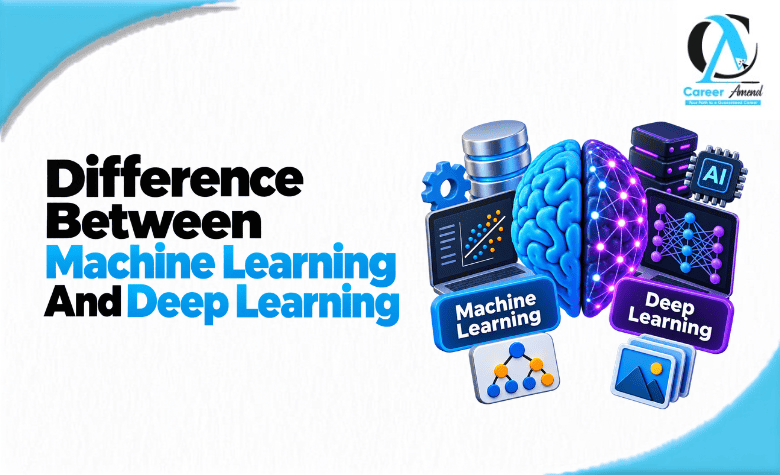
Difference Between Machine Learning and Deep Learning
- Understanding How Machine Learning and Deep Learning Relate
- Machine learning teaches systems to find patterns
- Deep learning uses layered neural networks
- The AI hierarchy removes the confusion
- Comparing Machine Learning and Deep Learning by How They Learn
- Traditional machine learning depends on selected features
- Deep learning learns many features from data
- Both methods need careful testing
- Difference Between Machine Learning and Deep Learning in Practice
- Machine learning often fits structured data
- Deep learning needs more data and computing power
- Accuracy must fit the real project
- Choosing the Right Approach for Real-World Applications
- Traditional machine learning suits many business tasks
- Deep learning fits perception and language
- Hybrid systems combine both methods
- How to Select the Best Model
- Start with the data and the goal
- Consider explanation and risk
- Use a staged selection process
- Common Misunderstandings About Machine Learning and Deep Learning
- Deep learning is part of machine learning
- Deep learning is not always more accurate
- People still guide both systems
- Conclusion:
Email spam filters, recommendation engines, voice assistants, medical scanners, and self-driving systems all use AI. Yet the terms machine learning and deep learning often get used as if they mean the same thing. They describe related methods, but they are not identical.
The difference between machine learning and deep learning affects your data needs, computing costs, development time, model speed, and ability to explain results. Traditional machine learning often works well with structured data and carefully chosen features. Deep learning is better suited to complex patterns in images, audio, video, and text.
The key point is easy to remember: deep learning is a specialized branch of machine learning. It is not a separate field.
Understanding How Machine Learning and Deep Learning Relate
Machine learning teaches systems to find patterns
Machine learning trains algorithms with examples instead of relying only on fixed, hand-coded rules. A dataset contains inputs, called features, and sometimes known answers, called labels. The trained model uses those patterns to make predictions on new data.
During training, the model adjusts its internal settings to reduce errors. During inference, it applies what it learned to new inputs, such as a loan application or incoming email. Common methods include decision trees, linear regression, logistic regression, support vector machines, and k-means clustering.
Supervised learning uses labeled examples. Unsupervised learning finds groups or patterns without labels, while reinforcement learning improves behavior through rewards and penalties. These methods support credit-risk assessment, customer segmentation, spam detection, and demand forecasting.
Deep learning uses layered neural networks
Deep learning uses neural networks with an input layer, hidden layers, and an output layer. Each layer transforms the information it receives, helping the model build more useful internal representations.
The network learns by changing weights and biases. A loss function measures prediction error, and backpropagation sends that error through the network so training can adjust the weights. As explained in IBM's deep learning explainer, activation functions help neural networks model complex, non-linear patterns.
Convolutional neural networks, or CNNs, work well with visual data. Transformer-based models handle language and other sequential data, including translation, text generation, and speech tasks.
The AI hierarchy removes the confusion
Artificial intelligence is the broad field of building systems that perform tasks linked to human intelligence. Machine learning is one way to build those systems by allowing them to learn from data. Deep learning is a machine learning method based on multi-layer neural networks.
The relationship is clear: all deep learning is machine learning, but not all machine learning is deep learning. A decision tree is machine learning without deep learning. A neural network with many hidden layers is both.
Comparing Machine Learning and Deep Learning by How They Learn
Traditional machine learning depends on selected features
Traditional machine learning often needs feature engineering. People select, clean, transform, and combine useful inputs before training the model.
For a spam filter, features might include word counts, sender details, and the number of links. A fraud model might use transaction frequency, purchase amount, location, and time of day. Good features can make a simple model highly effective, especially when domain experts understand the problem well.
Deep learning learns many features from data
Deep learning can learn features directly from raw or lightly processed data. In image recognition, early layers may detect edges, while later layers combine edges into shapes, textures, and objects.
This automatic feature learning reduces some manual work, but it does not remove the need for data preparation. Teams still need suitable inputs, accurate labels, sound model design, and careful testing. Poor or biased data can produce poor results, no matter how large the neural network is.
Both methods need careful testing
Machine learning and deep learning can suffer from overfitting, underfitting, data leakage, and class imbalance. Overfitting happens when a model performs well on training examples but poorly on new ones. Underfitting happens when the model fails to capture useful patterns even in its training data.
A strong workflow separates data into training, validation, and test sets. The Google Machine Learning Crash Course guidance on dataset splits recommends testing with data that is separate, representative, and free of duplicates from training data.
Start with clean data and a simple baseline. Then select metrics that match the goal, such as recall for missed fraud or precision for unwanted spam. Test the final model on conditions that resemble real use.
Difference Between Machine Learning and Deep Learning in Practice
Machine learning often fits structured data
Traditional machine learning works well with rows and columns in databases, spreadsheets, financial records, customer profiles, and sensor readings. Decision trees, random forests, gradient-boosting models, and linear models are common choices for these tasks.
A company may use machine learning to predict customer churn, detect fraud, forecast inventory, or assess loan risk. These projects often have limited but useful data, and a carefully designed feature set can give strong results without a large neural network.
Recommendation systems can use either approach. A model based on user age, product category, purchase history, and ratings may work well with traditional machine learning.
Deep learning needs more data and computing power
Deep learning is often a better fit for images, speech, video, natural language, and high-frequency sensor streams. These inputs contain complex relationships that are hard to describe with a short list of human-made features.
Large neural networks usually require more training data, storage, and computing power than traditional models. GPUs, specialized processors, distributed training, and cloud services can reduce training time, but they also add cost and system complexity.
Transfer learning can reduce the burden. A team can adapt a model trained on a related task instead of starting with random weights. More data and a larger model still do not guarantee better results.
Accuracy must fit the real project
Deep learning may improve accuracy, but it can also increase training time, inference cost, latency, maintenance needs, and deployment effort. Traditional models are often easier to inspect and explain, which matters in credit decisions, health services, and other high-impact settings.
A small model may be the better choice for a mobile app or real-time system with strict response limits. A complex model may be unsuitable if its extra accuracy does not justify its cost.
Choose the simplest model that meets the required accuracy, reliability, compliance, speed, and scale.
Choosing the Right Approach for Real-World Applications
Traditional machine learning suits many business tasks
Structured business data often favors traditional machine learning. Possible uses include churn prediction, customer lifetime value, credit scoring, demand planning, fraud detection, and risk classification.
Gradient boosting, random forests, and linear models are useful candidates, but no algorithm wins every task. Test several methods on the same dataset and compare their results, speed, cost, and ease of explanation.
Deep learning fits perception and language
Deep learning is well suited to image classification, object detection, speech recognition, document classification, translation, and text generation. It can also support medical image analysis and autonomous-driving perception systems.
These uses need strict testing because errors can harm people. Medical models require clinical validation and human oversight. Driving systems need testing across weather, roads, lighting, traffic, and unusual events.
Hybrid systems combine both methods
A practical AI system may use deep learning to extract representations, then pass those representations to a traditional classifier. A fraud platform might combine neural networks with rules, statistics, and a gradient-boosting model.
A simpler model can provide a baseline, fallback, or clear comparison point. Testing multiple approaches helps teams see whether deep learning offers a real gain rather than assuming its complexity will help.
How to Select the Best Model
Start with the data and the goal
First identify whether your data is structured or unstructured, labeled or unlabeled, static or constantly changing. Then define the task: classification, regression, ranking, generation, detection, or clustering.
Set acceptable error levels before choosing a model. A missed cancer signal, a false fraud alert, and a wrong product suggestion do not carry the same cost. Check that your data includes the users, conditions, and edge cases the system will face.
Consider explanation and risk
Ask who must understand each prediction. A bank may need to explain a credit decision, while a photo app may accept a less transparent model for image tagging.
Review privacy, fairness, security, audit, and regulatory needs. Document data sources, assumptions, limits, test results, and monitoring plans. Deep learning can be used in high-risk settings, but it often needs extra tools and review to explain its outputs.
Use a staged selection process
Build a simple baseline first. Measure accuracy, cost, speed, stability, and interpretability before adding complexity.
If the baseline fails, test targeted improvements such as better features, more data, transfer learning, or a deep neural network. Review the full lifecycle, including deployment, retraining, monitoring, and maintenance. Select deep learning when testing shows a meaningful advantage.
Common Misunderstandings About Machine Learning and Deep Learning
Deep learning is part of machine learning
Both methods learn patterns from data, require training, and need evaluation. Their main difference is the model structure and how features are learned.
Deep learning is not a competing category beside machine learning. It is one specialized approach within it.
Deep learning is not always more accurate
A well-built traditional model can outperform deep learning on structured data. A neural network may struggle when labels are scarce, data is noisy, or the training examples do not match real use.
Larger models can also raise cost, delay, and maintenance needs. Accuracy must be judged beside fairness, reliability, speed, and explanation quality.
People still guide both systems
Humans define the problem, approve the data, choose success measures, review errors, and decide how predictions should affect people. Models also need monitoring because user behavior and real-world data change.
For high-impact decisions, human review remains essential. AI can support judgment, but it does not remove responsibility.
Conclusion:
Machine learning is the broader field, while deep learning uses multi-layer neural networks within that field. Traditional machine learning often performs well on structured data, needs human-designed features, and offers easier deployment and explanation.
Deep learning can learn complex representations from images, audio, video, and text. It often needs more data, computing power, and technical skill, so its extra complexity should solve a real problem.
Begin with a clear goal and a strong baseline. Compare methods on representative data, then choose deep learning only when its tested benefits justify the added cost and risk.
Frequently Asked Questions