
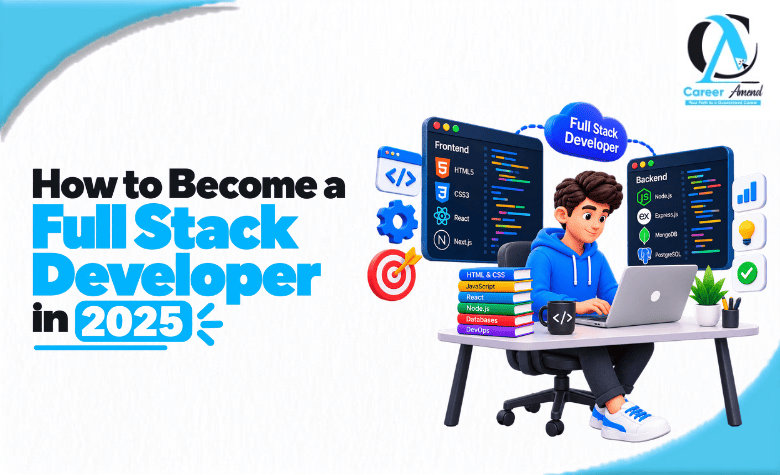
How to Become a Full Stack Developer in 2025: Roadmap
- How to Become a Full Stack Developer in 2025
- Understand the Full Stack Developer Role
- Strengthen Programming and Web Fundamentals
- Choose One Primary Technology Stack
- Build Front-End Skills That Employers Can See
- Master HTML, CSS, and JavaScript
- Add a Modern Front-End Framework
- Make Interfaces Accessible and Fast
- Develop Back-End and Database Skills
- Create Useful APIs and Server Applications
- Design Databases Before Writing Features
- Add Security, Testing, and Reliability
- Use Professional Tools to Ship Applications
- Work With Git and Team Practices
- Automate Testing and Deployment
- Turn Projects Into Proof of Skill
- Build Complete Projects With Real Constraints
- Document Decisions and Prepare for Interviews
- Full Stack Developer Roadmap: Learn in the Right Order
- Follow Stages That Build on Each Other
- Measure Progress With Real Outcomes
- Find Full Stack Developer Jobs in 2025
- Target Roles and Show Results
- Keep Your Skills Current
- Conclusion:
A single web application may involve a button in the browser, server-side rules, database queries, APIs, cloud hosting, and security checks. Companies need developers who can connect those parts and fix problems across the stack. Learning how to become a full stack developer in 2025 means building strong basics, choosing one main stack, and proving your skills with working projects.
You do not need every language or framework. You need practical knowledge of front-end development, back-end systems, databases, testing, Git, deployment, and security. This full stack developer roadmap shows what to learn, how long it may take, and how to prepare for full stack developer jobs in 2025.
How to Become a Full Stack Developer in 2025
Understand the Full Stack Developer Role
A full stack developer works on the client side and server side of a web application. The role may include building interfaces, writing business logic, designing database tables, creating APIs, testing features, and fixing production bugs.
Responsibilities vary by company and experience level. A small team may expect one developer to manage deployment and cloud logs, while a larger team may divide front-end, back-end, and platform work. Full stack does not mean equal mastery in every area. It means you can work across the main parts of an application and understand how they connect.
Strengthen Programming and Web Fundamentals
Start with variables, functions, conditions, loops, objects, error handling, and modules. Add data structures, basic algorithms, object-oriented programming, and functional programming ideas. These skills help you read unfamiliar code and make better technical choices.
Learn how browsers send requests through DNS, HTTP, servers, and databases. Study methods, status codes, headers, cookies, sessions, authentication, and authorization. Build small exercises without frameworks so you can see what the tools are doing.
Choose One Primary Technology Stack
Pick one front-end framework, one back-end framework, one relational database, and one deployment platform. A JavaScript or TypeScript stack might use React, Node.js, Express or NestJS, and PostgreSQL. Other solid options include React with Django or FastAPI, React or Angular with Spring Boot, and React or Blazor with ASP.NET Core.
Choose based on local job listings, learning resources, project goals, and long-term support. PostgreSQL is a strong first database because it teaches SQL and works with many languages. Avoid switching stacks every few weeks. Depth in one stack is more useful than shallow knowledge of ten tools.
Build Front-End Skills That Employers Can See
Master HTML, CSS, and JavaScript
Use semantic HTML for clear page structure and accessible content. Learn CSS Flexbox, Grid, responsive layouts, mobile-first design, and readable typography. JavaScript should include the DOM, modules, asynchronous code, forms, validation, and browser debugging tools.
Before using a framework, recreate a public interface with your own code. This exercise builds skill with spacing, layout, buttons, forms, and responsive behavior without copying private code or branding.
Add a Modern Front-End Framework
React, Angular, and Vue organize larger applications through components. Learn props, state, events, routing, layouts, API requests, loading states, empty states, and error handling. TypeScript adds safer types and can reduce mistakes as projects grow.
Start with local state. Add a state library only when shared data or complex updates make it necessary. The Stack Overflow Developer Survey 2024 reflects the continued use of JavaScript, HTML/CSS, TypeScript, and React, but your portfolio matters more than a popularity chart.
Make Interfaces Accessible and Fast
A working interface can still fail users. Test keyboard navigation, visible focus states, color contrast, form labels, touch targets, and screen-reader-friendly HTML. Follow WCAG-informed practices and check pages with browser tools and Lighthouse.
Optimize images, reduce unnecessary JavaScript, and test more than one screen size. Learn the basics of Core Web Vitals and cross-browser testing. Every portfolio project should work on a mobile viewport and with a keyboard.
Develop Back-End and Database Skills
Create Useful APIs and Server Applications
Learn REST resource naming, routing, middleware, controllers, request validation, response formats, and structured errors. Add authentication with sessions or tokens, then study refresh-token concepts and role-based authorization. Pagination, filtering, sorting, search, logs, and rate limits make an API feel closer to real production work.
REST should come before GraphQL. Document each API with sample requests, responses, required permissions, and error codes. This makes your work easier to test and easier for another developer to understand.
Design Databases Before Writing Features
Learn tables, relationships, primary keys, foreign keys, constraints, indexes, joins, aggregations, and transactions. Practice normalization, then learn when careful denormalization can improve speed. Use migrations and seed data so another person can set up your database.
PostgreSQL is a practical first choice. MongoDB may fit document-heavy data, while Redis can support caching or short-lived values. Design the schema before coding and explain your choices with an entity relationship diagram.
Add Security, Testing, and Reliability
Protect passwords with secure hashing and validate all input. Study SQL injection, cross-site scripting, cross-site request forgery, secure headers, dependency risks, and rate limiting. The OWASP Top 10 is a useful reference for common web application risks.
Write unit tests for business rules, integration tests for APIs, and end-to-end tests for key user flows. Test failed logins, forbidden actions, bad input, and missing records. Plan for backups, monitoring, graceful errors, and dependency updates instead of testing only the happy path.
Use Professional Tools to Ship Applications
Work With Git and Team Practices
Learn repositories, commits, branches, merges, pull requests, code reviews, and conflict resolution. Write commit messages that explain the change, not the mood of the developer. Use issues, project boards, README files, and technical notes to practice team habits.
Feature branches and pull requests are useful even for personal projects. They create a record of your decisions and give you practice reviewing changes before release.
Automate Testing and Deployment
Store settings in environment variables and keep secrets out of Git. A basic CI workflow should install dependencies, run formatting checks, lint the code, execute tests, and build the application on each pull request. Docker basics can help you run consistent development environments.
Deploy front ends, back-end services, and managed PostgreSQL databases through a platform you can understand. Learn domain names, DNS, HTTPS, logs, uptime checks, object storage, and simple rollback steps. Basic AWS, Azure, or Google Cloud knowledge is useful, but beginners do not need every cloud service.
Turn Projects Into Proof of Skill
Build Complete Projects With Real Constraints
A strong portfolio has two or three complete applications, not twenty unfinished tutorials. Build an appointment platform with user roles, an inventory tool with orders, a task manager with collaboration, or a content site with moderation. Each project should include authentication, database relationships, validation, responsive screens, tests, and deployment.
Add one meaningful constraint, such as file uploads, audit history, scheduled tasks, search, payments, or different user permissions. A clear problem and thoughtful trade-offs make a project stronger than a basic CRUD clone.
Document Decisions and Prepare for Interviews
Each README should explain the users, features, stack, architecture, database design, API, setup steps, tests, limits, and planned improvements. Add screenshots, a short demo, and a small architecture diagram, but keep the written instructions complete.
Practice explaining how a browser request reaches the server and database. Be ready to discuss authentication, schema choices, API trade-offs, security risks, performance fixes, debugging, and deployment. Use this project walkthrough: problem, design, challenge, decision, result, and next improvement.
Full Stack Developer Roadmap: Learn in the Right Order
Follow Stages That Build on Each Other
Begin with HTML, CSS, JavaScript, Git, the command line, and web basics. Then learn a front-end framework, responsive design, accessibility, and API use. Next, add a back-end framework, REST APIs, authentication, SQL, and database work.
Finish with testing, security, CI/CD, Docker, deployment, and monitoring. After that, refine your portfolio, practice interviews, meet developers, and apply for roles. Move forward after completing a project at each stage.
Measure Progress With Real Outcomes
Spend about 30% of study time reading or watching lessons and 70% building, debugging, documenting, or reviewing code. Official documentation, structured courses, books, open-source issues, and peer feedback are useful when they lead to practice. Treat AI-generated code as a draft that you must read, test, and explain.
Useful milestones include:
- Build a responsive interface without a tutorial.
- Design tables and write SQL joins.
- Create secure login and role checks.
- Test important business rules.
- Deploy an application with a custom domain.
- Explain its architecture in a code review.
How long it takes to become a full stack developer depends on prior experience and weekly study time. A focused learner may become job-ready in several months, while someone studying part time may need a year or more.
Find Full Stack Developer Jobs in 2025
Target Roles and Show Results
Search for junior full stack developer, software developer, web application developer, software engineer, and application developer roles. A front-end role with API work or a back-end role with database duties can also begin your full stack career path.
Study repeated requirements in job listings instead of chasing every keyword. Your resume should show the primary stack, deployed links, GitHub repositories, testing, deployment, and measurable results where you can prove them. Remove unfinished tutorial clones and feature your best two or three projects.
Keep Your Skills Current
Continue improving TypeScript, security, testing, cloud deployment, accessibility, performance, observability, and AI-assisted development with human review. Evaluate a new tool only when it solves a project problem, improves maintenance, or appears often in your target job listings.
Conclusion:
Becoming a full stack developer in 2025 requires connected skills, not a list of every popular technology. Learn the web basics, choose one stack, build front-end and back-end systems, design databases, secure and test your code, use Git, and deploy real applications.
Choose your stack today. Define one useful project, set a weekly schedule, and publish a working version before you feel ready. Building, deploying, and explaining your decisions will take you further than waiting to learn everything first.




.png)