
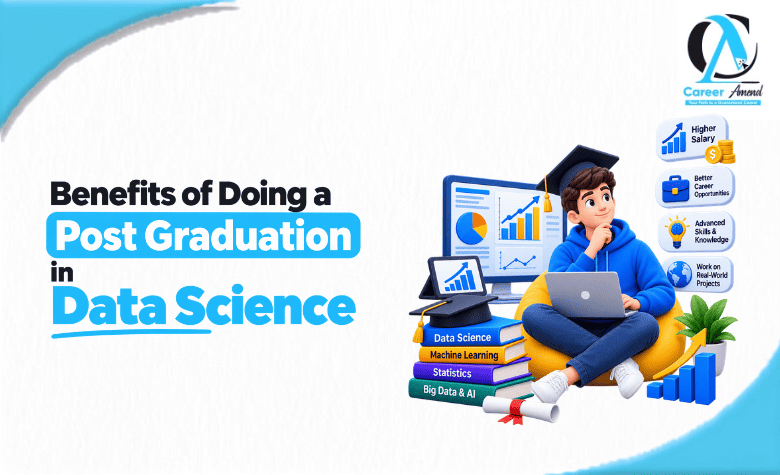
Benefits of Post Graduation in Data Science | Career Guide
- Why Post Graduation in Data Science Builds Advanced Skills
- Strengthen statistics, programming, and machine learning
- Work with complex and unstructured data
- Use responsible and explainable AI
- Expand Career Opportunities With Post Graduation in Data Science
- Qualify for specialized data and analytics roles
- Move from analysis to strategic responsibility
- Apply data science across industries
- Gain Practical Experience Through Projects and Industry Exposure
- Build portfolio projects with business value
- Work with faculty, peers, and employers
- Turn academic work into professional evidence
- Build Credibility, Networks, and Communication Skills
- Improve eligibility for data-focused roles
- Learn from faculty and industry practitioners
- Create Long-Term Flexibility in a Changing Technology Market
- Prepare for AI, research, and further study
- Support a career change from an adjacent field
- Decide Whether Postgraduate Data Science Study Is Worth It
- Compare the program, format, and prerequisites
- Measure cost, return, and career outcomes
- Ready to Build Your Data Science Skills?
- Conclusion:
A stalled career, weak coding skills, or rising pressure to keep up with artificial intelligence can make your next step unclear. A post graduation in data science can help you move beyond basic reports and learn how to turn raw data into useful business decisions.
The value goes beyond a certificate. A strong postgraduate program can build your technical skills, business sense, professional credibility, and career options. It can also help you move into data roles from fields such as finance, engineering, marketing, healthcare, or operations.
In the United States, the U.S. Bureau of Labor Statistics Occupational Outlook Handbook reports that data scientist jobs are projected to grow by 35% between 2025 and 2035. The occupation had a median annual wage of $120,230 in May 2025. These figures apply to the United States, not every country. The World Economic Forum's Future of Jobs Report 2025 also studies how technology and skills may affect work through 2030, using views from more than 1,000 employers.
Why Post Graduation in Data Science Builds Advanced Skills
Strengthen statistics, programming, and machine learning
Postgraduate study usually goes further than a short course. You may study probability, statistical inference, linear algebra, Python, R, SQL, supervised learning, unsupervised learning, deep learning, optimization, and model testing.
The key benefit is learning why a method works, when it fits a problem, and where it may fail. Compare course plans before enrolling. Look for statistics, machine learning, data engineering, model deployment, and business applications, rather than a course focused only on software tools.
Work with complex and unstructured data
Real projects rarely contain clean spreadsheets. Postgraduate assignments may involve missing values, high-dimensional data, text, images, streaming records, or time-series data. You learn data cleaning, feature engineering, exploratory analysis, pipeline design, and data quality checks.
Some programs also include cloud platforms, Spark, Docker, Git, databases, visualization tools, and MLOps. Check that these tools appear in assessed work, not only in a short optional module.
Use responsible and explainable AI
Data professionals must understand privacy, bias, fairness, security, transparency, and model interpretation. A model can produce accurate results and still cause harm if its data is unfair or its decisions cannot be explained.
Look for courses that discuss the NIST AI Risk Management Framework, GDPR where relevant, and the data protection law in your target country. NIST's framework, released in 2023, helps organizations manage risks linked to AI design, development, use, and evaluation.
Expand Career Opportunities With Post Graduation in Data Science
Qualify for specialized data and analytics roles
A postgraduate qualification can support several career paths. Data scientists build models and extract insights. Machine learning engineers focus more on production systems, while data engineers create the pipelines and platforms that move and store data.
Data analysts and business intelligence analysts often work with reports, dashboards, and business questions. Product analysts study user behavior, quantitative analysts work with financial models, and AI consultants connect technical solutions with business needs. Your entry route will depend on prior education, work experience, portfolio quality, location, and the employer.
Move from analysis to strategic responsibility
Advanced training can help you progress from dashboard creation to forecasting, experiments, risk analysis, recommendation systems, and predictive modeling. A qualification alone will not guarantee a promotion, so connect your work to results.
Record outcomes such as shorter reporting times, better forecast accuracy, higher customer retention, or lower operating costs. This evidence helps managers see the value of your skills.
Apply data science across industries
Finance uses data science for fraud detection and risk scoring. Healthcare uses it for patient analysis and resource planning, while retail, manufacturing, logistics, telecom, energy, education, sports, and government use it for forecasting, planning, and service improvement.
Choose a focus based on hiring demand, your interests, local rules, and access to relevant projects or internships. Domain knowledge can help you stand out when paired with strong technical work.
Gain Practical Experience Through Projects and Industry Exposure
Build portfolio projects with business value
Employers want proof that you can define a problem, handle imperfect data, test a model, explain results, and suggest a useful action. A capstone project gives you practice with the full process: data collection, exploration, modeling, evaluation, interpretation, and recommendations.
Each portfolio project should include a clear problem statement, baseline model, evaluation metrics, visualizations, data limits, reproducible code, documentation, and ethical risks. A supply chain forecasting project is more useful for an operations role than a copied tutorial on a generic dataset.
Work with faculty, peers, and employers
Group projects, research work, internships, hackathons, and employer challenges build skills that exams cannot measure. You practice version control, peer review, project planning, stakeholder interviews, and clear presentations.
Before applying, check whether the program shares capstone partners, internship results, faculty research areas, employer links, and student project examples. This research can reveal the difference between applied training and a theory-heavy course.
Turn academic work into professional evidence
Publish selected work on GitHub, LinkedIn, a personal site, or a technical blog. Explain the problem, approach, result, limits, and practical meaning in plain language. Present the same project in two forms: a technical version for data specialists and an executive summary focused on cost, risk, decisions, and expected outcomes.
Build Credibility, Networks, and Communication Skills
Improve eligibility for data-focused roles
A recognized postgraduate qualification can show structured training and commitment, especially when you are changing fields. Some employers, graduate schemes, research teams, and regulated sectors may ask for advanced study. Others may still require a first degree in computer science, mathematics, engineering, statistics, or a related subject.
Review job descriptions for your target roles before choosing a program. Match repeated requirements against the modules, assessments, projects, and graduate outcomes.
Learn from faculty and industry practitioners
Faculty research, guest lectures, employer events, alumni groups, and career services can provide feedback and access to internships or referrals. Check faculty publications or industry work, alumni career paths, employer partnerships, placement support, and the strength of the student data community.
Communication matters as much as model accuracy. Data professionals must explain uncertainty, gather requirements, answer concerns, influence decisions, and guide projects with mixed technical and nontechnical teams.
Create Long-Term Flexibility in a Changing Technology Market
Prepare for AI, research, and further study
Depending on the course, you may encounter natural language processing, computer vision, causal inference, reinforcement learning, generative AI, cloud analytics, edge computing, or automated machine learning. Favor programs that teach core concepts, testing, security, governance, and deployment rather than short-lived tools.
A dissertation or research project can prepare you for a PhD, applied research, R&D, or technical specialist work. You may build skills in literature reviews, hypothesis design, experiments, reproducible work, academic writing, and presenting findings.
Support a career change from an adjacent field
Software developers, engineers, economists, finance workers, marketers, healthcare staff, and operations specialists often bring useful domain knowledge. A postgraduate program adds programming, statistics, modeling, and data systems.
Start by listing your transferable skills and technical gaps. Then choose suitable electives, complete domain-based projects, seek an internal data assignment or internship, and target hybrid roles that combine your previous experience with new data skills.
Decide Whether Postgraduate Data Science Study Is Worth It
Compare the program, format, and prerequisites
Full-time courses may finish sooner, while part-time, online, hybrid, and executive formats can suit working professionals. Compare teaching hours, assessment methods, project depth, computing access, student support, and the time needed for independent practice.
Check your readiness in programming, statistics, databases, linear algebra, and basic calculus. A foundation course may be a better starting point if several of these areas are new to you.
Measure cost, return, and career outcomes
Add tuition, living costs, software or equipment, travel, financing costs, and lost income. Salary results vary by country, sector, job title, experience, and economic conditions. Use government wage data, audited employment reports, and reliable graduate surveys rather than accepting a promotional placement rate without checking its sample, dates, and definition.
Use this self-check before applying:
- Can you afford the full cost and workload?
- Which role and industry are you targeting?
- Which skills do current job adverts demand?
- Does the curriculum fill your gaps?
- Will you complete substantial practice outside class?
- Does the program show credible graduate outcomes?
Ready to Build Your Data Science Skills?
If you're looking to strengthen your skills in data analysis, machine learning, statistics, and practical data science, explore the PGP in Data Science by Career Amend. The program combines online learning, hands-on assignments, industry-oriented training, and practical projects to help you develop job-relevant data science skills.
Explore the PGP in Data Science →
Conclusion:
The main benefits of doing a post graduation in data science include stronger technical ability, wider career access, practical project experience, professional credibility, useful networks, and greater flexibility across industries.
The program matters as much as the qualification. Choose a curriculum linked to your target roles, verify outcomes with reliable sources, seek applied projects and industry exposure, and build a public portfolio that shows measurable results.
For career changers and working professionals, post graduation in data science can be a smart investment when it combines sound fundamentals, real project work, responsible AI practice, and a clear plan for using the new skills.
Frequently Asked Questions

.png)