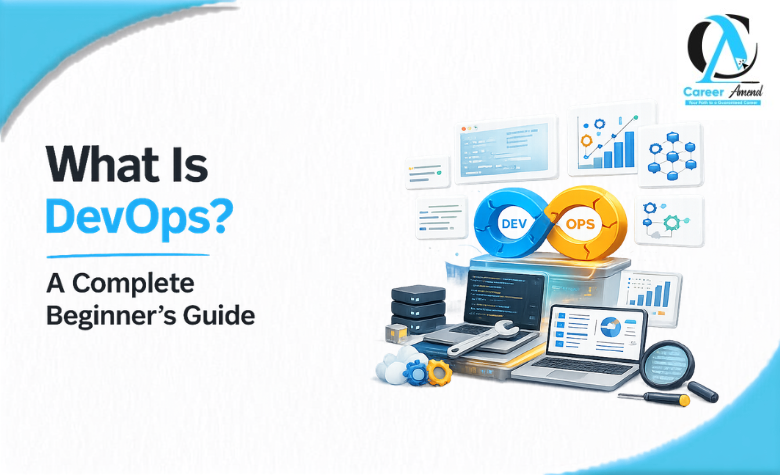
What Is DevOps? A Complete Beginner's Guide (2026)
- What Is DevOps?
- Understanding DevOps in Simple Terms
- Why DevOps Matters
- Faster Software Delivery
- Better Collaboration
- Improved Software Quality
- Greater Automation
- Enhanced Customer Satisfaction
- Increased Scalability
- Better Security
- Key Goals of DevOps
- Why Companies Prefer DevOps
- How Does DevOps Work?
- The DevOps Lifecycle
- 1. Planning
- 2. Development
- 3. Continuous Integration (CI)
- 4. Continuous Testing
- 5. Continuous Delivery (CD)
- 6. Continuous Deployment
- 7. Monitoring and Feedback
- Understanding CI/CD in DevOps
- Infrastructure as Code (IaC)
- Automation in DevOps
- Popular DevOps Tools
- Git
- GitHub
- Jenkins
- Docker
- Kubernetes
- Terraform
- Ansible
- AWS DevOps Services
- Microsoft Azure DevOps
- Prometheus and Grafana
- Why DevOps Tools Matter
- Benefits of DevOps
- 1. Faster Software Delivery
- 2. Better Collaboration
- 3. Higher Software Quality
- 4. Improved Security
- 5. Increased Automation
- 6. Better Scalability
- 7. Reduced Downtime
- DevOps vs Traditional Software Development
- Essential Skills Required for DevOps
- Linux Fundamentals
- Version Control
- Programming and Scripting
- Cloud Computing
- Containers
- CI/CD Pipelines
- Infrastructure as Code
- Monitoring
- Communication and Collaboration
- Career Opportunities in DevOps
- How to Learn DevOps as a Beginner
- Step 1: Learn Linux Basics
- Step 2: Master Git
- Step 3: Learn a Programming Language
- Step 4: Understand Networking
- Step 5: Learn Containers
- Step 6: Study Cloud Platforms
- Step 7: Build CI/CD Pipelines
- Step 8: Practice Real Projects
- Common Challenges in DevOps
- Future of DevOps
- Conclusion:
- Ready to Start Your DevOps Journey?
The software industry has changed dramatically over the past decade. Businesses no longer release software once or twice a year—they deliver updates weekly, daily, or even multiple times a day. To keep up with this rapid pace, organizations need a development approach that combines speed, quality, and reliability. This is where DevOps comes into the picture.
If you've ever wondered what is DevOps, you're not alone. DevOps has become one of the most sought-after skills in the technology industry, helping companies deliver better software faster while improving collaboration between teams. Whether you're a student, aspiring software engineer, system administrator, or IT professional, understanding DevOps can open doors to exciting career opportunities.
In this beginner-friendly guide, you'll learn what DevOps is, how it works, its core principles, popular tools, career opportunities, benefits, challenges, and how to start learning DevOps from scratch.
What Is DevOps?
DevOps is a modern software development methodology that combines software development (Dev) and IT operations (Ops) to improve collaboration, automate workflows, and deliver software faster with higher quality.
Traditionally, developers built applications while operations teams managed deployment and maintenance. Since these teams often worked independently, communication gaps led to delays, deployment failures, and slow software releases.
DevOps removes these barriers by encouraging collaboration, automation, continuous integration, continuous testing, and continuous deployment. Instead of working in isolated departments, developers, testers, security teams, and operations engineers work together throughout the entire software development lifecycle.
The primary goal of DevOps is to deliver reliable software quickly while maintaining stability, security, and scalability.
Today, companies such as Netflix, Amazon, Google, Microsoft, and Spotify use DevOps practices to deploy software updates continuously without disrupting user experience.
Understanding DevOps in Simple Terms
Imagine a restaurant kitchen.
- Chefs prepare the food.
- Servers deliver it to customers.
- Managers ensure everything runs smoothly.
If these teams don't communicate properly, customers receive incorrect orders or experience delays.
Software development works similarly.
Developers create applications, while operations teams deploy and maintain them. Without collaboration, bugs, downtime, and deployment issues become common.
DevOps ensures everyone works together using automation, shared responsibilities, and continuous feedback.
Why DevOps Matters
Modern businesses rely heavily on software. Customers expect applications to be available 24/7, perform efficiently, and receive regular updates with new features.
Without DevOps, organizations often face:
- Slow software releases
- Communication gaps
- Deployment failures
- Increased operational costs
- Longer recovery times
- Poor customer experience
DevOps solves these challenges by streamlining development and operations processes.
Some key reasons why DevOps has become essential include:
Faster Software Delivery
Automation enables teams to release updates much more frequently than traditional development models.
Better Collaboration
Developers, testers, operations engineers, and security professionals work together instead of functioning in isolated departments.
Improved Software Quality
Continuous testing helps identify bugs early, reducing production failures and improving application reliability.
Greater Automation
Tasks like testing, deployment, infrastructure management, and monitoring become automated, minimizing manual effort and human error.
Enhanced Customer Satisfaction
Frequent updates, faster bug fixes, and stable applications create a better experience for end users.
Increased Scalability
Cloud platforms combined with Infrastructure as Code (IaC) make it easy to scale applications based on demand.
Better Security
Modern DevOps integrates security practices into every stage of development, often referred to as DevSecOps.
Key Goals of DevOps
The main objectives of DevOps include:
- Deliver software faster
- Improve collaboration between teams
- Automate repetitive tasks
- Reduce deployment failures
- Increase software reliability
- Improve application security
- Enable continuous improvement
- Respond quickly to customer feedback
- Minimize downtime
- Enhance business agility
Organizations adopting DevOps often experience shorter release cycles, improved operational efficiency, and higher customer satisfaction.
Why Companies Prefer DevOps
Businesses across industries adopt DevOps because it helps them remain competitive in today's fast-moving digital world.
Major advantages include:
- Faster product launches
- Continuous software improvements
- Lower infrastructure costs
- Better team productivity
- Reduced manual errors
- Easier cloud adoption
- Improved disaster recovery
- Greater business flexibility
Whether it's an e-commerce platform, banking application, healthcare system, or streaming service, DevOps enables organizations to deliver reliable software at scale.
How Does DevOps Work?
Now that you understand what is DevOps, it's important to learn how it works in real-world software development.
DevOps is not a single tool or technology. Instead, it is a culture and set of practices that bring together development, testing, operations, and security teams throughout the software development lifecycle. Every stage—from planning and coding to deployment and monitoring—is connected through automation and continuous feedback.
Rather than waiting weeks or months to release new features, DevOps enables organizations to deliver small, reliable updates frequently. Automation tools handle repetitive tasks such as testing, building, deployment, and infrastructure management, allowing teams to focus on innovation instead of manual processes.
A typical DevOps workflow looks like this:
- Plan the project and define requirements.
- Write and manage source code.
- Build the application automatically.
- Test the software continuously.
- Package the application for deployment.
- Deploy it to servers or cloud platforms.
- Monitor performance and collect feedback.
- Improve the application based on insights.
This continuous cycle helps businesses release software faster while maintaining high quality and reliability.
The DevOps Lifecycle
The DevOps lifecycle is a continuous process that ensures software is developed, tested, deployed, and improved efficiently. Each stage plays a critical role in delivering reliable applications.
1. Planning
Everything begins with planning. Teams gather business requirements, define project goals, prioritize features, and create development roadmaps.
Agile methodologies such as Scrum and Kanban are commonly used during this phase to organize tasks and manage development sprints. Effective planning ensures that everyone understands project objectives before coding begins.
2. Development
In this stage, developers write application code using programming languages such as Java, Python, JavaScript, Go, or C#.
Version control systems like Git help developers collaborate efficiently by tracking code changes, managing branches, and preventing conflicts.
Modern DevOps teams also conduct code reviews and follow coding standards to maintain software quality.
3. Continuous Integration (CI)
Continuous Integration (CI) is one of the core principles of DevOps.
Whenever developers commit new code, an automated pipeline builds the application and runs tests immediately. This allows teams to detect bugs early rather than waiting until the project is nearly complete.
Benefits of Continuous Integration include:
- Faster bug detection
- Improved code quality
- Easier collaboration
- Reduced integration issues
- Faster development cycles
CI helps ensure that new code integrates smoothly with the existing application.
4. Continuous Testing
Testing is automated throughout the development process instead of being performed only at the end.
Automated tests may include:
- Unit testing
- Integration testing
- Functional testing
- Performance testing
- Security testing
- Regression testing
Continuous testing ensures that every software update meets quality standards before deployment.
5. Continuous Delivery (CD)
After successful testing, the application is automatically prepared for release.
In Continuous Delivery, software is always deployment-ready, but the final production deployment usually requires manual approval.
This approach allows organizations to release new features whenever they choose without additional preparation.
6. Continuous Deployment
Continuous Deployment takes automation one step further.
Once all automated tests pass successfully, the application is automatically deployed to production without manual intervention.
Companies like Netflix and Amazon use Continuous Deployment to release updates multiple times every day while maintaining high service availability.
7. Monitoring and Feedback
After deployment, teams continuously monitor application performance, server health, user behavior, and system logs.
Monitoring helps identify:
- Performance bottlenecks
- Security threats
- Server failures
- User experience issues
- Application crashes
The collected feedback is used to improve future software releases, making the DevOps lifecycle a continuous improvement process.
Understanding CI/CD in DevOps
One of the most frequently used terms in DevOps is CI/CD.
CI/CD stands for:
- Continuous Integration (CI) – Frequently merging code changes into a shared repository where automated builds and tests run.
- Continuous Delivery (CD) – Ensuring the software is always ready for deployment after passing automated checks.
- Continuous Deployment (CD) – Automatically releasing validated changes to production without manual approval.
Together, CI/CD pipelines reduce manual work, improve consistency, and enable faster software delivery with fewer errors.
Infrastructure as Code (IaC)
Infrastructure as Code (IaC) is another important DevOps practice.
Instead of manually configuring servers, networks, and cloud resources, engineers define infrastructure using code and configuration files.
This approach offers several advantages:
- Faster infrastructure provisioning
- Consistent environments
- Reduced human errors
- Easy scalability
- Version-controlled infrastructure
- Faster disaster recovery
Popular IaC tools include Terraform, AWS CloudFormation, and Ansible.
Automation in DevOps
Automation is the foundation of DevOps.
Instead of spending hours on repetitive tasks, teams automate processes such as:
- Code building
- Software testing
- Server configuration
- Application deployment
- Infrastructure provisioning
- Security scans
- Monitoring and alerting
- Backup management
Automation increases efficiency, reduces mistakes, and allows developers to focus on building better software.
Popular DevOps Tools
DevOps relies on a wide range of tools, each designed for a specific stage of the software development lifecycle.
Git
Git is the most widely used version control system. It helps developers manage source code, track changes, and collaborate efficiently.
Primary use: Source code management
GitHub
GitHub hosts Git repositories in the cloud and enables collaboration through pull requests, issue tracking, and code reviews. It also supports GitHub Actions for CI/CD automation.
Primary use: Code hosting and collaboration
Jenkins
Jenkins is one of the most popular open-source automation servers used to build, test, and deploy applications automatically.
Primary use: Continuous Integration and Continuous Delivery
Docker
Docker packages applications and their dependencies into lightweight containers, ensuring they run consistently across different environments.
Primary use: Containerization
Kubernetes
Kubernetes automates the deployment, scaling, and management of containerized applications, making it easier to run applications in production.
Primary use: Container orchestration
Terraform
Terraform enables Infrastructure as Code by allowing engineers to provision cloud resources using configuration files.
Primary use: Infrastructure provisioning
Ansible
Ansible automates server configuration, software installation, and application deployment without requiring agents on target machines.
Primary use: Configuration management and automation
AWS DevOps Services
Amazon Web Services offers services such as CodePipeline, CodeBuild, CodeDeploy, and CloudFormation to streamline DevOps workflows in the cloud.
Primary use: Cloud-native DevOps
Microsoft Azure DevOps
Azure DevOps provides integrated services for project management, source control, CI/CD pipelines, testing, and artifact management.
Primary use: Enterprise DevOps platform
Prometheus and Grafana
These tools work together to monitor infrastructure and applications. Prometheus collects metrics, while Grafana visualizes them through dashboards.
Primary use: Monitoring and observability
Why DevOps Tools Matter
No single DevOps tool can handle every task. Successful DevOps teams build toolchains where each solution addresses a specific need—from coding and testing to deployment and monitoring.
The right combination of tools helps organizations:
- Accelerate software delivery
- Improve collaboration
- Automate repetitive workflows
- Enhance application reliability
- Scale infrastructure efficiently
- Monitor system performance in real time
By integrating these tools into a unified pipeline, businesses can deliver secure, high-quality software faster and more consistently.
Benefits of DevOps
Organizations across industries have embraced DevOps because it improves software quality while accelerating delivery. By combining collaboration, automation, and continuous improvement, DevOps enables teams to work more efficiently and respond quickly to changing business needs.
1. Faster Software Delivery
One of the biggest advantages of DevOps is faster release cycles. Automated testing and CI/CD pipelines reduce the time required to build, test, and deploy applications. Businesses can launch new features and bug fixes much more frequently than with traditional development methods.
2. Better Collaboration
DevOps removes barriers between development, operations, testing, and security teams. Shared responsibilities and open communication reduce misunderstandings and create a more productive work environment.
3. Higher Software Quality
Continuous integration and automated testing help identify issues early in the development process. As a result, software releases are more stable, reliable, and less prone to errors.
4. Improved Security
Modern DevOps incorporates security throughout the software lifecycle, often referred to as DevSecOps. Automated vulnerability scanning, security testing, and compliance checks help reduce security risks before applications reach production.
5. Increased Automation
Routine tasks such as testing, deployment, infrastructure provisioning, monitoring, and configuration management are automated. This saves time, minimizes manual errors, and improves overall efficiency.
6. Better Scalability
Cloud platforms and Infrastructure as Code (IaC) allow organizations to scale applications quickly based on user demand. Resources can be provisioned or removed automatically without extensive manual effort.
7. Reduced Downtime
Continuous monitoring and automated rollback mechanisms help detect issues quickly and restore services with minimal disruption, ensuring a better experience for users.
DevOps vs Traditional Software Development
Understanding the difference between DevOps and traditional software development helps illustrate why DevOps has become the preferred approach for modern organizations.
|
Feature |
Traditional Development |
DevOps |
|
Team Structure |
Separate Development and Operations Teams |
Collaborative Cross-Functional Teams |
|
Deployment Frequency |
Monthly or Quarterly |
Daily or Multiple Times per Day |
|
Testing |
Mostly Manual |
Continuous Automated Testing |
|
Deployment |
Manual |
Automated CI/CD Pipelines |
|
Feedback |
Late in the Development Cycle |
Continuous Feedback |
|
Infrastructure |
Manual Configuration |
Infrastructure as Code (IaC) |
|
Scalability |
Limited |
Cloud-Native and Highly Scalable |
|
Security |
Often at the End |
Integrated Throughout Development |
DevOps focuses on continuous improvement, enabling organizations to innovate faster while maintaining high software quality.
Essential Skills Required for DevOps
If you're planning a career in DevOps, developing the right technical and soft skills is essential.
Linux Fundamentals
Most cloud servers run on Linux, making command-line knowledge and system administration skills highly valuable.
Version Control
Understanding Git, repositories, branching, merging, and pull requests is fundamental for collaborative software development.
Programming and Scripting
Knowledge of Python, Bash, PowerShell, or Go helps automate repetitive tasks and manage infrastructure efficiently.
Cloud Computing
Familiarity with cloud platforms such as AWS, Microsoft Azure, or Google Cloud Platform is increasingly important for DevOps professionals.
Containers
Learning Docker and Kubernetes enables developers to package, deploy, and manage applications consistently across environments.
CI/CD Pipelines
Hands-on experience with tools like Jenkins, GitHub Actions, GitLab CI/CD, or Azure DevOps helps automate software delivery.
Infrastructure as Code
Tools like Terraform, Ansible, and CloudFormation simplify infrastructure management through code.
Monitoring
Understanding monitoring tools such as Prometheus, Grafana, ELK Stack, or Datadog helps maintain application health and performance.
Communication and Collaboration
DevOps is as much about culture as technology. Strong teamwork, communication, and problem-solving skills are just as important as technical expertise.
Career Opportunities in DevOps
The demand for DevOps professionals continues to grow as organizations accelerate digital transformation and cloud adoption.
Popular career roles include:
- DevOps Engineer
- Site Reliability Engineer (SRE)
- Cloud Engineer
- Platform Engineer
- Build and Release Engineer
- Automation Engineer
- Infrastructure Engineer
- Kubernetes Administrator
- CI/CD Engineer
- Cloud Solutions Architect
Professionals with DevOps expertise are employed in industries such as finance, healthcare, e-commerce, telecommunications, gaming, education, and government.
As organizations continue adopting cloud-native technologies, skilled DevOps professionals are expected to remain in high demand worldwide.
How to Learn DevOps as a Beginner
Starting a DevOps career may seem overwhelming, but following a structured learning path makes the process much easier.
Step 1: Learn Linux Basics
Understand file systems, shell commands, permissions, networking, and process management.
Step 2: Master Git
Learn how to create repositories, commit changes, manage branches, and collaborate using GitHub or GitLab.
Step 3: Learn a Programming Language
Python and Bash are excellent choices for automation and scripting.
Step 4: Understand Networking
Study concepts such as IP addresses, DNS, HTTP, HTTPS, SSH, load balancing, and firewalls.
Step 5: Learn Containers
Practice creating Docker images and managing containers before moving on to Kubernetes.
Step 6: Study Cloud Platforms
Begin with one major cloud provider, such as AWS, Azure, or Google Cloud, and learn its core services.
Step 7: Build CI/CD Pipelines
Create simple projects using Jenkins or GitHub Actions to automate builds and deployments.
Step 8: Practice Real Projects
Hands-on experience is the fastest way to develop practical DevOps skills. Deploy personal projects, automate workflows, and experiment with cloud infrastructure.
Common Challenges in DevOps
Although DevOps offers significant advantages, organizations may face challenges during implementation.
Some common obstacles include:
- Resistance to cultural change
- Legacy systems that are difficult to modernize
- Lack of automation expertise
- Security and compliance concerns
- Managing complex cloud environments
- Tool integration challenges
- Skill gaps within teams
Successful DevOps adoption requires continuous learning, leadership support, and a culture of collaboration.
Future of DevOps
The future of DevOps is closely tied to advancements in cloud computing, artificial intelligence, automation, and cybersecurity.
Key trends shaping the future include:
- AI-powered DevOps (AIOps)
- DevSecOps for integrated security
- GitOps for infrastructure management
- Serverless computing
- Kubernetes-first deployments
- Edge computing
- Platform engineering
- Increased use of Infrastructure as Code
- Intelligent automation and predictive monitoring
As organizations continue to modernize their software delivery processes, DevOps will remain one of the most valuable skills in the technology industry.
Conclusion:
Understanding what is DevOps is the first step toward mastering one of the most in-demand technologies in modern software development. By combining development and operations through automation, collaboration, and continuous improvement, DevOps enables organizations to build, test, and deploy software more efficiently than ever before.
Whether you're a student exploring career options, a developer looking to improve your workflow, or an IT professional transitioning into cloud technologies, learning DevOps can significantly enhance your technical skills and career opportunities. Start with the fundamentals, practice real-world projects, and gradually build expertise in cloud platforms, containers, CI/CD, and Infrastructure as Code. With consistent learning and hands-on experience, you'll be well-prepared for a successful career in the evolving world of DevOps.
Ready to Start Your DevOps Journey?
If you're excited to build a career in cloud computing, automation, and modern software development, now is the perfect time to enroll in a DevOps Certification Program. A well-structured program will help you master essential skills like Linux, Git, Docker, Kubernetes, Jenkins, Terraform, AWS, CI/CD pipelines, and Infrastructure as Code (IaC) through hands-on projects and real-world scenarios. Whether you're a student, a working professional, or someone looking to switch careers, learning DevOps can open doors to high-demand job opportunities across the globe. Start your DevOps learning journey today and gain the practical skills needed to succeed in the rapidly evolving IT industry.
Frequently Asked Questions