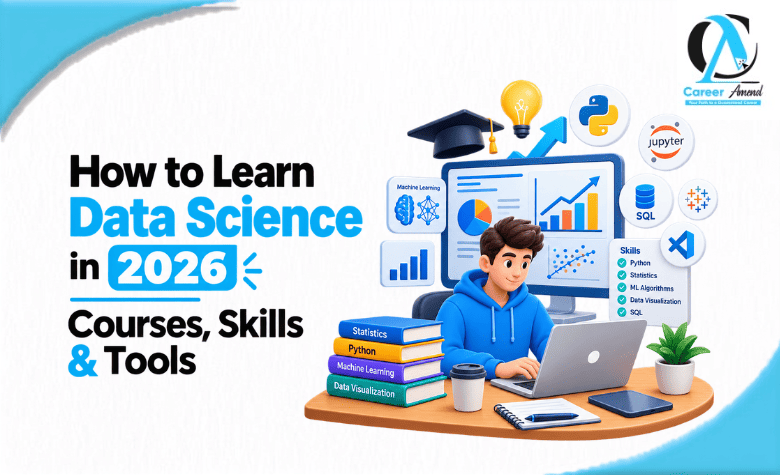
How to Learn Data Science in 2026: Courses, Skills & Tools
- Build the Foundation Before Advanced Data Science Topics
- Learn practical mathematics for data analysis
- Develop Python, SQL, and notebook skills
- Understand the full data path
- Choose a Data Science Career Path That Matches Your Goals
- Compare common data careers
- Match the plan to your background
- Choose Data Science Courses That Produce Practical Skills
- Follow a sensible course sequence
- Compare free, paid, and formal options
- Build a Modern Data Science Toolkit Without Chasing Trends
- Start with a compact core stack
- Add dashboards, cloud, and AI with care
- Turn Coursework Into a Portfolio Employers Can Review
- Build projects around real questions
- Show the complete workflow
- Prepare for Data Science Jobs Through Deliberate Practice
- Practice interviews and analytical reasoning
- Build communication and workplace experience
- Follow a Sustainable 2026 Learning Roadmap
- Move through clear learning phases
- Measure output, then keep learning
- Conclusion:
A spreadsheet, a public dataset, and a clear question can teach more than hours of passive video lessons. Yet many beginners get stuck choosing between Python, artificial intelligence, machine learning, dashboards, cloud tools, and dozens of career titles.
Learning data science in 2026 requires a focused plan. The goal is not to learn every tool. It is to build useful skills in the right order, apply them to real problems, and create work that employers can review. The U.S. Bureau of Labor Statistics projects 34% growth in data scientist jobs from 2024 to 2034, with about 23,400 openings each year, but strong evidence of skill still matters. (BLS Occupational Outlook Handbook)
Build the Foundation Before Advanced Data Science Topics
Strong basics help you understand why code works. They also reduce your need to copy tutorials without knowing whether the result is valid.
Learn practical mathematics for data analysis
Start with descriptive statistics, probability, distributions, correlation, confidence intervals, hypothesis tests, and regression coefficients. Add linear algebra concepts such as vectors and matrices, plus basic calculus to understand how models reduce error.
Analytics roles often need strong statistics and clear interpretation. Machine learning and research roles may require more linear algebra, optimization, and probability. Use spreadsheets, Python, and charts to connect each idea to real data instead of focusing on proofs alone.
Develop Python, SQL, and notebook skills
Learn Python variables, functions, loops, data structures, modules, and error handling. Then practice with NumPy and pandas, using public CSV files or APIs rather than isolated syntax drills.
SQL remains essential for structured data. Study filtering, joins, grouping, subqueries, common table expressions, and window functions. Use Jupyter Notebook to combine code, charts, explanations, and findings in one place.
Understand the full data path
Learn how data moves from collection to storage to analysis. Review relational databases, data warehouses, data lakes, cloud storage, APIs, and basic pipelines at a high level.
Your cleaning work should address missing values, duplicates, outliers, inconsistent formats, and data leakage. Record assumptions, limitations, privacy concerns, consent issues, fairness risks, explainability needs, and security choices in every project.
Choose a Data Science Career Path That Matches Your Goals
Job titles vary by company, so read job descriptions before selecting advanced courses. A target role gives your study plan a clear filter.
Compare common data careers
A data analyst works mainly with SQL, spreadsheets, reports, dashboards, and descriptive analysis. An analytics engineer builds warehouse models, transformation workflows, tests, and documentation.
A data scientist studies experiments, statistics, prediction, and business decisions. A machine learning engineer focuses more on software, deployment, monitoring, and production systems. A data engineer builds ingestion, storage, pipelines, orchestration, and infrastructure.
Match the plan to your background
Business professionals can build on industry knowledge while adding SQL, statistics, and charts. Software developers often need more practice with experiments, model evaluation, and business questions.
Math and science graduates may need stronger programming, databases, and writing skills. Career changers should choose one role, build a few focused projects, and use transferable experience instead of trying to study every branch of data work.
Set six- to twelve-month milestones. Examples include writing SQL queries without help, completing exploratory analysis on unfamiliar data, training a baseline model, publishing a dashboard, and explaining results to a nontechnical audience.
Choose Data Science Courses That Produce Practical Skills
A popular course may still leave you with little work to show. Judge each option by its practice, feedback, project quality, current syllabus, total cost, refund terms, and graduate outcomes.
Follow a sensible course sequence
Begin with Python, SQL, statistics, data cleaning, exploratory analysis, and visualization. Study supervised and unsupervised learning after you can inspect data and explain a basic analysis.
Leave cloud systems, deployment, and narrow specialties until the core ideas feel familiar. Look for graded exercises, realistic datasets, code reviews, projects, and assessments that test decisions rather than memory.
Compare free, paid, and formal options
Free courses reduce risk and work well for early testing. Paid programs may add structure, mentors, feedback, projects, or career support, but certificates do not replace demonstrated ability.
Boot camps can move quickly, while university courses often offer more theory and formal assessment. University open courseware, structured platforms, official documentation, books, research papers, and public competitions can work together. Kaggle Learn offers short practical courses at no cost, with certificates available.
Build a Modern Data Science Toolkit Without Chasing Trends
A small, reliable stack is enough for many beginner and intermediate projects. Learn the workflow first, then add tools when a project needs them.
Start with a compact core stack
Use Python, pandas, NumPy, Jupyter, SQL, and Git. Add Matplotlib, Seaborn, or Plotly for charts, then use scikit-learn for classical machine learning.
The scikit-learn getting started guide covers fitting models, preprocessing, pipelines, cross-validation, and evaluation. Its pipeline approach also helps reduce data leakage during model work. Publish selected projects through GitHub with clear README files.
Add dashboards, cloud, and AI with care
Choose one dashboard tool, such as Power BI or Tableau, for stakeholder reports. Later, learn Docker, APIs, and basic deployment, then choose one cloud provider: AWS, Azure, or Google Cloud.
Advanced learners can study workflow scheduling, experiment tracking, model registries, testing, and monitoring. Generative AI tools can explain errors, create practice questions, suggest test cases, and compare methods. Check every answer, code sample, statistic, and citation, and never paste private or regulated data into an external tool.
Turn Coursework Into a Portfolio Employers Can Review
Certificates show that you completed training. Projects show how you think, clean data, test ideas, and communicate results.
Build projects around real questions
Choose a government dataset, academic source, nonprofit dataset, or established competition platform. Define a business, scientific, policy, or social question before writing code.
Document the data source, license, cleaning choices, assumptions, and limits. Compare a simple baseline with a stronger model when prediction fits the problem. Every chart should support a clear finding, and every conclusion should explain what decision it may inform.
Show the complete workflow
A strong project frames a measurable outcome, acquires and inspects data, cleans it, explores patterns, and creates a baseline. If modeling is suitable, split the data correctly, validate the model, select useful metrics, and explain errors.
Share the result through GitHub, a dashboard, a short case study, or a small deployed app. Include setup steps, requirements, methods, results, limitations, failed approaches, and next steps. Two to four focused projects are better than many unfinished repositories.
Prepare for Data Science Jobs Through Deliberate Practice
Job preparation should begin before the portfolio feels perfect. Employers often test technical reasoning, judgment, and communication together.
Practice interviews and analytical reasoning
Work on Python and SQL problems, probability, statistics, experiment design, data cleaning, and model evaluation. Analysts may face dashboard or business cases, while data science candidates may explain model choice, validation, and uncertainty.
Say your reasoning aloud. After each practice session, record the mistake, the correct approach, and one question that remains unclear.
Build communication and workplace experience
Write summaries using four parts: context, finding, implication, and recommendation. Ask clarifying questions before analysis, separate correlation from causation, and explain uncertainty in plain language.
Seek internships, freelance tasks, nonprofit work, open-source contributions, competitions, peer reviews, mock interviews, and mentorship. Track your role, tools, results, and lessons so you can discuss them clearly in applications.
Follow a Sustainable 2026 Learning Roadmap
A flexible plan works better than a fixed promise of becoming job-ready in a set number of weeks. Adjust the pace for your background, available time, and target role.
Move through clear learning phases
Start with Python, SQL, spreadsheets, statistics, Git, and basic charts. Continue with cleaning, exploratory analysis, dashboards, communication, and case studies. Add machine learning, feature engineering, validation, and interpretation next.
Production skills come after local work feels comfortable. Study APIs, deployment, cloud basics, testing, monitoring, and reproducibility. The career phase includes networking, interviews, targeted applications, and portfolio updates.
Measure output, then keep learning
Track finished analyses, SQL tasks, dashboards, models, written explanations, and presentations rather than hours watched. Set weekly deliverables with clear acceptance rules, then ask a peer or mentor whether the work is understandable and reproducible.
Follow official documentation, technical blogs, research summaries, and job postings. Learn new tools by applying them to an existing project, while continuing to strengthen statistics, SQL, software practices, experimentation, and communication.
Conclusion:
Learning data science in 2026 means building evidence of skill in a useful sequence. Start with Python, SQL, statistics, visualization, Git, and sound data habits. Choose one target role, then add machine learning, dashboards, cloud tools, or deployment as that role requires.
AI assistants can speed up practice, but they cannot replace judgment. A job-ready portfolio asks clear questions, uses trustworthy data, evaluates results properly, explains limits, and offers a useful conclusion.
Choose one structured course this week. Schedule regular practice, select a small public dataset, and publish a finished project before starting another one.
Frequently Asked Questions